

Charlie McCrary: One reason I wanted to bring you three and your books into conversation is that they are all about religion and empire in the nineteenth-century United States and its sites of imperial expansion. When I was in grad school, it felt like the nineteenth century was where it’s at. That’s what everybody was doing. But now, the field of American religious studies is very twentieth– and twenty-first-century focused. So, one thing I appreciate about these books is that they’re bringing us back to the nineteenth century. To start, could you talk about what you mean by empire, why the nineteenth century, and, by way of doing so, give a quick introduction of your books and what they’re doing?
Sonia Hazard: For what it’s worth, I think the nineteenth century is still where it’s at. But I’ve observed the trends you’re seeing as well. I was attracted to the early national and antebellum periods because of historiography and its extreme contradictions–especially the bizarre simultaneity of narratives of freedom and unfreedom in this period. These competing claims about how power worked during this time. Scholars have used this period to theorize that American religion is all about democratization, and personal choice, and agency. And other scholars have used the same evidence to show how America was a space of discipline, secularism, coercion, constraints, empire, settler colonialism, and so on. And I felt like anywhere where there is that much fundamental disagreement is an interesting zone. It seemed to me that we needed different vocabularies to talk about power, and in my book, “infrastructure” became that vocabulary for me.
Empire of Print is about how evangelicals leveraged the medium of mass print during a time of U.S. expansion in the early national period, in order to make the U.S. more Christian. I look specifically at the media corporation the American Tract Society (ATS), which is a massive publisher, one of the largest in the world at the time. Between its founding in 1825 and the Civil War, it published over 5.6 billion pages of print.
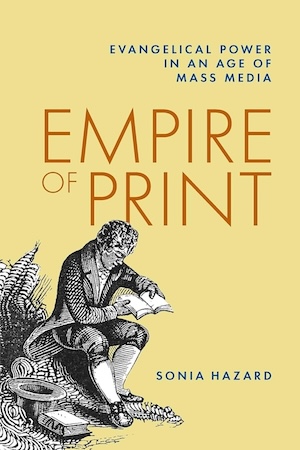
My argument is that evangelical power in this period not only stemmed from the quantity or ubiquity of media objects, or from the content of their messages, but it was dependent on what I’m calling media infrastructure. And that infrastructure was a pervasive, though unappreciated, style of evangelical power in the nineteenth century. For me, infrastructure was a term that recognized the development of material apparatuses that were intended to guide reader response but did not fully control or fully make these readers into subjects.
Together, I think our three books demonstrate that the nineteenth century is a crucial period for understanding processes of key concern to American religious history and American history broadly, such as colonization, modernity, and empire. Here we can interrogate the roots of concepts like religious freedom, the nation-state, race and racialization, religious encounter, and so on, as these were being worked out in the nineteenth century.
The nineteenth century is a useful place to theorize about or theorize from, in order to understand religious studies. It’s axiomatic in religious studies that the idea of religion is a modern idea. And it’s also becoming axiomatic to note that we live in a secular age and that the secular divides religion into its own discrete sphere. Jeff and Tisa’s books especially show us how those secular notions of religion emerged from contested spaces in the nineteenth-century United States.
Jeffrey Wheatley: I love the history of words. I love how words rise and fall out of fashion, how they accrue and change meaning over time. The project began as a study of U.S. occupation of the Philippines. I became interested in the discourse of fanaticism because, for the U.S. colonial administration–for the military and police powers in the late nineteenth-century Philippines–fanaticism was not just a way of representing Filipinos as less than or inferior. It was a term of strategic concern: religious fanaticism is driving this delusional resistance to the U.S. And so, I began to ask, when did Americans start using fanaticism in this way? And that’s what took me back to the antebellum period.
American Fanatics is about how and why Americans became more invested in the concept of fanaticism as it became, I argue, a key term for how many Americans, especially but not exclusively those in power, categorize and assessed religion in this antebellum environment–an environment that was defined by religious innovation and energy, which is a key metaphor throughout my book.
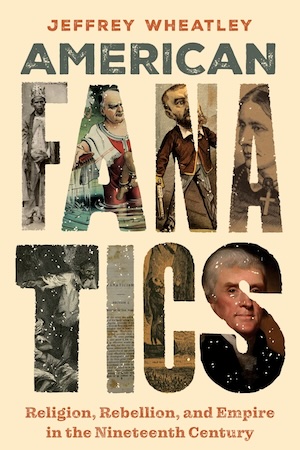
In the antebellum period, when the language of fanaticism appeared, it was mostly an intra-Protestant theological debate about propriety, especially of the emerging emotional style of evangelicalism. But then, as evangelical style became more powerful and prominent, white evangelicals kind of flipped the script, emphasizing this fine distinction: our emotionalism, our style of devotion is enthusiastic, and that’s actually necessary for the health of the nation and the empire. The fanatics are these other marginalized, colonized, or enslaved communities, and so the discourse of fanaticism becomes a tool of governing and marginalization, driven by the projects of imperialism and slavery, which are tied together in the nineteenth century.
As Sonia mentioned, another distinctive feature of the nineteenth century is there’s all these really fascinating theories of agency and emotion and willfulness. I see that across all three of our books: there are these underlying fundamental concepts of human agency, and sometimes ideas of how human agency is differential across different races. One term I use is “affectability.” How are humans motivated? How do they act but are also acted upon? There are these really interesting ideas, sometimes implicit and sometimes explicit, of human attention and motivation.
Tisa Wenger: I love the nineteenth century also. In writing my previous book, Religious Freedom, which focuses on the early twentieth century, I had planned to start earlier. I did some research that became the place where this book, Spirits of Empire, begins: with the story of the encounter between William Henry Harrison, then governor of the Indiana Territory, and the Shawnee leader and visionary Tenskwatawa, who with his brother Tecumseh was building an intertribal coalition, centered at a town in Indiana called Prophetstown, against the United States. Harrison was weaponizing religion and liberal ideas about free expression, religious freedom, and free conscience to limit what he thought Tenskwatawa should be able to do with his visions. He was saying, “We white Americans believe in the freedom of conscience and basically religion shouldn’t be political.” I wanted to think about how religion was configured, weaponized, and taking shape in the early republic.
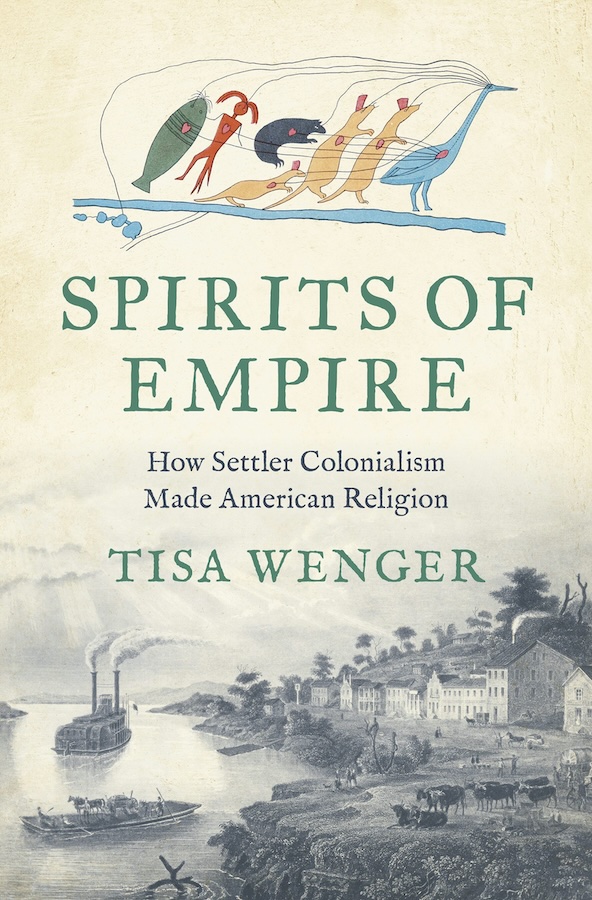
The main argument of the book is in its subtitle: How Settler Colonialism Made American Religion. The core argument is that there is this characteristically American form of secularism–I name it settler secularism–that takes shape in this period that is structured by settler colonialism, and that we can’t understand how religion unfolds, or how religion is governed, or how Americans conceptualize religion without paying attention to settler colonialism.
I decided to focus regionally on what we now call the Midwest, starting with what was, at that time, called the Northwest Territory. I spend a lot of time in Michigan and Indiana, and then some of the later chapters move west with some of its main characters into Illinois, Missouri, Kansas. Missionaries were following Indian removals, a form of genocidal ethnic cleansing, and they also accompanied white settlers moving west, including early Mormons, etc. I also focus on Native actors, especially Anishinaabe, Potawatomi, Odawa, Ojibwe people, and how they grappled with this situation, and how their own religious traditions take shape, how some of them choose to embrace Protestant or Catholic forms of Christianity to make their way through this new imperial order that is being forced on them. I also extend some of my earlier work on how Native people come to conceptualize their own traditions as religion. I see that happening here in this time period, as Anishinaabe people are confronting the power of U.S. empire, and in conversation with missionaries, they begin to conceptualize some of their own traditions as religion. So the book covers a lot of ground. It has an overlapping cast of characters and feels to me like a sprawling book.
Hazard: I just want to say, you said your book was sprawling, but I think what forces history to be sprawling is the frame of empire. And I notice this about all of our books. You can’t say that nineteenth-century America was any one thing, because it was actually being built during this time. It was being worked out in these material encounters among different interests, and it’s rapidly expanding, tenfold between 1790 and 1861. And people are bringing this enormous variety of influences, from Africa, Europe, Latin America, Indigenous influences, and so on. In this moment, things were not yet hegemonic because everything was still in this extremely contingent moment. We see that in these three books, and I see that as a bit different from some of the studies in an earlier period of the historiography of the nineteenth century, which tended to talk about America as being one thing or the other.
Wenger: First of all, in the early republic, where we’re all starting, the United States didn’t cover nearly the expanse of the continent that it covers today. Most of the continent was still controlled by Native nations. U.S. empire was limited in this period. I try to make clear in the early chapters of my book the immense power that Native nations had demographically, politically, in every possible way across the continent. They were so strong, and so much of early U.S. really cannot be understood without accounting for their presence and their action. And so, to your point, Sonia, about the framework of empire–also its limits, right? So many people had their own lives and struggles at this time, entirely out of the control of the U.S. empire, which was expanding but not all-powerful.
McCrary: And there’s a disjuncture between the grand rhetoric of empire and the material circumstances, what actually happens on the ground. This leads me to the next question. In our field sometimes there’s an overdetermined distinction between more of a historical materialist approach and, on the other hand, discourse analysis. All three books do plenty of discourse analysis. But each of you, in different ways, is making the point that we have to attend to the material circumstances, first and foremost, before we analyze the rhetoric being used in these texts of empire. I’d like it if each of you could speak to this issue. Is there a tension between discourse and materiality? How have you navigated that historiographical issue?
Hazard: Well, it’s always both discourse and materiality, but … it’s mostly about materiality. And I say that only a little tongue-in-cheek. In my book, by “media Infrastructure,” I mean the material format a media object takes and also how they materially move through space. I’ve always been interested in questions about techniques and mechanics. In grad seminars, we learned about conversion, and I always wanted to know, What are the exact steps that lead to someone’s conversion? Like, break it down for me. In the mission encounter, who said what and when, and how did they say it in such a way that it seemed compelling and not a total farce? Or, in my research, how exactly did a publisher manage to change somebody’s mind through the medium of printed papers that were issued thousands of miles from the scene of reading? I think that infrastructure names those nitty-gritty details.
For that reason, I’ve sometimes been left wanting more from secular studies, especially when the secular is invoked as secularity. Jeff makes this distinction in the beginning of his book–and it’s also schematized by Charlie and Jeff in this amazing article that they wrote early on in graduate school–between secularity as a sort of epistemological condition, or a set of habits of thought, or as a kind of metaphysics, versus secularism as a mode of governance, how the ideology is deployed to manage populations. What Tisa and Jeff both do so well is through their investment in that second part of secularism, how it actually hits the ground; it’s not just this bloodless metaphysics.
I especially like Jeff’s chapter, which I think is the spiritual heart of the book, on the encounters between the U.S. occupier aggressors and Filipinos. It’s centered on anting-anting, these charms that Filipinos thought had supernatural powers, including the power to repel bullets. So, if I’m reading you right, the Americans used the pervasiveness of anting-anting to show that Filipinos were not secular, and therefore incapable of self-government. But what’s so great about the chapter is that you show that it’s not like the Americans were fully secular, in that epistemological sense. They, too, understood the charms to be powerful. They had an understanding of more-than-human powers. The Americans were arguing that Filipinos were superstitious because they had the charms. And, at the same time, they also understood the charms to have power and would collect them as war trophies.
Wheatley: Yeah. Thank you so much. As I was reading your book, and your attention to infrastructure and the circulation of media, that is the chapter that was in my head, because of its points of connection. Tisa, in terms of spiritual-material objects, you offer a few examples, such as wampum. Putting those and the anting-anting alongside the tracts, these kinds of enchanted objects–how might we compare these things? At times, the ATS does seem to have some magical thinking about the tracts, as if they are these little critters that just go on their own, that have their own kind of agency and power that demands attention–or conversion. Regarding political secularism: if we’re thinking about discourse analysis done properly, it’s always both language and materiality, in the Foucauldian sense.
But in this project I wanted to shift away from the study of representations to study governance. Many of the effects of the discourse of fanaticism are, in my book, violence. I think at least three of my chapters have state executions. I have in mind Sylvester Johnson here, emphasizing the importance of studying governance, and Robert Orsi always paying attention to lived religious realities. And it was kind of hard to do that in a book that was organized around a concept. I feel like the materiality, the effects on the ground, kind of appear and then kind of disappear in a way that’s not quite as consistent as your focus, Sonia. But I’m curious about this question. To what extent can we think about anting-anting and maybe something like wampum alongside the tracts?
McCrary: If I can interject quickly here, to riff with that question–For many people in religious studies now, an entirely disenchanted “secular” methodology feels, if not quite untenable, at least problematic for a number of reasons. And yet, at least personally, I don’t really write sentences about stuff that the gods do. But at the same time, when you do that, you’re taking a side in the very debate you’re historicizing. There’s always this kind of tangle of post-secular scholarship. It matters, because you have to sort it out to write. How am I going to write about anting-anting? There are all these claims about them and their powers. How do I write that paragraph?
Wenger: I think Sonia’s book does such a brilliant job of helping us understand how material objects do exercise a kind of power. I wouldn’t use the language of agency, because I think agency is kind of a limited way to talk about human power and action as well. But, Sonia, you show us how the limits of material infrastructure make a difference, in a way that is inherent to the material objects, to the ability to distribute them, and that is a way in which they do have power.
I, too, love Jeff’s chapter on anting-anting. That chapter helps us think in an important way about the power of material objects: there’s something about the interaction between the people and the anting-anting that actually gives them power. I think we can bracket the question of whether believers see an inherent power in the objects aside from that, but we can definitely see as historians that they have power that has been attributed to them by people. And the American officials also attribute that power to the objects, even as they’re ridiculing the Filipinos for doing the same.
You mentioned wampum, which does show up in my book, but in connection with the tracts, the material objects that are more pertinent are doodem drawings (there’s an example on the book’s cover). It’s a material object in that it’s a piece of paper on which they had drawn the clan insignia. The doodem are a representation of the clan but also an expression of kinship with the animal, as well as land and water. And through that, they are arguing for that connection. Henry Rowe Schoolcraft connects this with “religion,” and as it becomes the word “totem,” it’s later picked up by Durkheim and then becomes a keyword for theorizing “religion.” But Anishinaabe people don’t think of it as “religion.”
Connecting this to questions about secularity and political secularism–hat I’m calling settler secularism creates a sharp binary between the material and the spiritual. I’m theorizing the epistemological systems that shape how we interact with objects and land, and we see them as just objects and ontologically distinct from the human. That’s different from the Indigenous system that sees kinship with land, water, other-than-human creatures. And so, when you’re talking, Charlie, about the limits of a secular frame that we’re all wrestling with, I’m trying to figure out how we can provincialize that secular assumption that material objects or/and the land itself is just a thing. How can we think in serious ways in our scholarship about that frame–which I also continue to work within, and continue to assume–as a kind of provincial secular one? I want to think about materiality and land and other-than-human creatures differently, in conversation with Indigenous epistemologies, ontologies, philosophies that we need to take seriously as thought partners and not just as objects of study.
Hazard: That’s such a rich set of reflections, and I want to pick up the last one. One thing that has been puzzling and preoccupying me lately is this: How does a group like the ATS, who are these elite white Protestants, on one hand occupy secularity in the first sense (If you asked them, Do you think humans and God are the only ones in charge? Do you think land has agency? They would say yes and no), but yet, on the other hand, they see no problem with engineering tracts that have what they describe as an inbuilt locomotive power, that will have a kind of agency of their own? And they see no contradiction there? So there are these layers of secularity and political secularism in the same individual at the same time that are actually contradictory.
Other scholars have been bringing this out. Jamie Brummit’s new book on Protestant relics in early America shows that these white Protestants loved relics. They dug up George Whitefield’s little finger and took away clothes from his crypt. And then they turned around and critiqued African, South Asian, Indigenous people for doing similar things. When Catholics would complain about this and say, “you guys are doing the same thing with this Whitefield stuff,” these Protestants would just totally innocently say, “no, we’re not.” And I find this really baffling!
I think the agency of materiality, it’s important to emphasize, doesn’t need to be, like, magic, if by that we mean some mysterious power emanating from the object. I think Jeff was getting at this in his analysis of anting-anting. Whatever magic is there is actually being activated through these relationships. Tisa, you were just mentioning this too. Humans and non-humans being engaged in ongoing relationships–that’s actually what activates these objects. It’s not the object on its own.
To address Charlie’s question about how to write and theorize about this. For me, that is not incompatible with a naturalistic point of view. Anting-anting having power, on a shared epistemological ground, makes sense to me. So, the power of material things doesn’t necessarily need to be investigated in the register of enchantment or supernaturalism. There’s a shared ground, and white Protestant moderns stand on it as well.
McCrary: There’s also a Marxist way to think about the accrual of value through circulation, too, so objects can be imbued with power and it’s not exactly spiritual or metaphysical in that way.
Wheatley: Thinking about the power of material objects, you’re right, it’s not about their inherent magical properties. It’s about the kind of relationality, the social context that gives them meaning. But what I love about your book, Sonia, is that their intrinsic physical properties matter; they can, in particular moments, demand someone’s attention, even against their will. The ATS had this vision of these tracts just kind of circling, and they realized, no, we actually have to build up the infrastructure. But at times, it seems like it kind of works the way they wanted, that people who at first might not want the tract discover it in the wild, and it hits them. There are parts, Sonia, where you are kind of invested in that: the tracts worked, in some way.
At first, I was skeptical of that, but as I kept reading and you were able to show some of the reception of them, I bought it. And then I also thought about Chick Tracts. They do–because they’re matter out of place, because you’re not expecting it–grab your attention, and that’s possible because of the format, because of the fonts, because of the illustrations. That is the materiality aspect that you highlight and insist is an important part of it. It’s not just the social context, and it’s not just the words.
McCrary: I’m spending my summer reading about attention. These theorists of attention think about the problem of people’s lack of agency over their own attention–it’s mostly about phones, right?–but this so-called “new attention economy” is all about grabbing your attention when you aren’t willingly giving it. Which is what a billboard does, which is what the tract does. But there seems to be some resonance of this conversation with this modern discourse of attention.
Wenger: I’m thinking about the way that when we write about objects like the anting-anting or the doodem–which is both a concept materially represented, and also the animal itself with which the clan has a particular relationship–there’s a way that if we insist on categorizing those things as enchanted or religious or spiritual that we’re buying into and re-inscribing the secular division. We are limiting and putting it in a kind of box of the religious. And that’s the very secular work, the secular operation, that I want to push back against. And so maybe that’s the reason that in this conversation we’re comfortable with saying, “We don’t have to talk about it as enchanted. We don’t have to talk about it as a religious or spiritual power. We can just think about its power, right?” I like that move, because it refuses the secular work of delineating the religious as something different, or something to be suspicious of. I think we do well to kind of get away from that in our own theorizing and categorizing things.
Hazard: Yeah, just riffing on that brilliant point, I tend to think that the secular work of putting brackets around religion as this protected space has prevented us from asking a lot of questions in religious studies. Was Joseph Smith really seeing an angel at his bedside? You can only kind of admire that from a distance, as a non-Mormon scholar, and observe its ontological difference from my own.
But if religion is not some rarefied sphere that needs special handling, needs gloves, you can ask all these other questions about it. You can ask, did Joseph Smith find something in the ground? You can ask empirical questions, like Anne Taves has been doing, about how cognitive processes of new religious movements develop. You could ask if everyone was drunk that night. I do think that we have kneecapped ourselves in some ways by making the secular move of saying that religion is something that is kind of other, that requires a different set of tools and perhaps mood in dealing with it than any other cultural phenomenon.
Wenger: One of the arguments I make in Spirits of Empire (and this isn’t entirely new to me) is that Christianity in settler secularism is able to play this very distinctive role. There are times when it’s in that same religion box to be specially protected, but then in the same breath, it’s also privileged in all kinds of ways, sometimes explicitly. My colleague Sally Promey’s book, Religion in Plain View, shows how Christianity is privileged materially on the landscape just by, for example, how many churches are at the center of town greens, and the way that creates a kind of layered privilege that has been historically instantiated by relations of imperial power. But also, Christianity is privileged in less obviously visible ways: by the way that the First Amendment and the history of jurisprudence understand what counts as religion in ways that privilege Christianity. And there are ways that, in my book, these authorities are privileging Christianity very explicitly as the religion of the United States, even as they are putting other kinds of religion in the religion box.
Wheatley: At times, I find the diverse ontologies compelling, but also I think the U.S. government, colonial administration was right: anting-anting don’t work in the literal sense; they don’t stop American bullets. We should pay attention to the moments of failure and what people do when the tract doesn’t work, doesn’t cause a conversion. Maybe someone recoils from Christianity because of whatever the heavy-handedness or something. Or what happens when the anting-anting don’t protect you? That also should be part of the analysis.
McCrary: I like this emphasis on failure. It reminds me of Jenna Supp-Montgomerie’s book (When the Medium Was the Mission), too, about the telegraph and American religion. Sonia and I read that book together, and I remember us remarking that like half of this book is about the telegraph breaking all the time. A tunnel needs to be re-dug, the wire needs to be fixed, and it’s just constantly not working.
I want to transition into a final set of questions. There’s been quite a lot of work in the last couple of decades about the formation of normative religious subjects. In the secularism studies frame, one way to think about the intervention of thinking about political secularism first is that it’s not just that people get some idea about what it means to be truly religious, and then they enforce that. No, the enforcement, or the colonial encounter, or the settler project, whatever exactly the setting, that happens, and then the categories of governance derived from that become generalized into, well, into the academic study of religion, for one.
So that’s one way that the materiality comes first. It’s not that it’s more important, but that at least in some cases, it’s chronologically prior. The site of theorization has to be constructed at a material level before the theorization happens. And oftentimes, the scholarship gets it reversed. We ask, how are these theories of religion put into action? No, no, other way around! So, I think all of you are contributing to that broader project, talking about how relatively elite white Christians, mostly Protestants, think about the normative religious subject, and how that intersects with race, gender, class (I especially appreciated Sonia’s attention to class, which often gets overlooked). What do you, or the three of you together, have to say that is new, and in what ways would you like to see people build on this conversation?
Hazard: What I have to say that is new is related to what is old. I think I’m more preoccupied than Tisa or Jeff with some of the old historiography of this period. Maybe I should interrogate that in myself, but these old white men continue to inspire me and bother me. I ask grad students to read Charles Foster and Clifford Griffin and Nathan Hatch and Mark Noll, because I think that there’s still a lot to work through there regarding how subjects are formed by power, what a subject is. My book attempts to answer some of those questions that I felt like were unresolved from those old controversies. But I’m inspired by Jeff and Tisa achieving escape velocity and moving on to different sorts of problems!
I would hope that our books could inspire students, especially those who are motivated by theoretical and conceptual questions, to look at the nineteenth century. These books show that the nineteenth century offers a set of sources for those who wish to understand these big, thorny, messy, conceptual questions about secular governance, empire, racialization, concepts of religion. And it’s a really rich ground, as this conversation has shown, to theorize the relationships between ideas and materiality.
Wheatley: I have this idea of the overflowing signifier. With problematic terms like fanaticism or occult, we often think of the language as being an empty or floating signifier. That is, there’s nothing really there. It’s just a term people use to describe people they disagree with or that they want to harm. And that’s part of it, but also these words accrue meanings and connotations over time. And sometimes our job is to wade through all those meanings, the overflow, to discern fact from myth from outright lie. I want to see more work that approaches these kinds of terms–religion, extremism, terrorism–in this way.
McCrary: Your approach reminded me of Dana Logan’s article on cults. A standard line is “cult is just a term for a religion we don’t like,” and she takes that and shows that it has a more specific meaning than that. There’s a lot of meaning; it’s a really loaded term. Maybe we should use it, maybe we shouldn’t, but just to brush it off and say it’s totally floating, that it can just be applied to anything, is clearly not quite correct.
Wenger: I want to continue to think about the diverse ways that people enter into U.S. empire. Whether Catholic, Indigenous, Mormon, etc., they also have interests and affiliations beyond it. But a lot of these folks end up being disciplined by or folded into the project of U.S. empire, and disciplined by what I’m calling settler secularism, to be a certain kind of religion. But I do think that discipline is never entirely complete, and you can see that by the comparative work that I do in the book to think about how these different groups are trying to get in on the action. And this also ends up being the case for some Native groups. They are incentivized to follow the rules. And there are arguments within any given human community, including Native communities, about how to best move forward under this circumstance. Do we want to take advantage of the resources that collaboration with this imperial order would provide us, or do we want to just refuse it entirely? I do think that’s really significant for anybody focusing on not just the nineteenth century, but history generally.
McCrary: Great. Well, thank you all so much. Thank you, Sonia Hazard, Tisa Wenger, and Jeffrey Wheatley, for your amazing books.
