
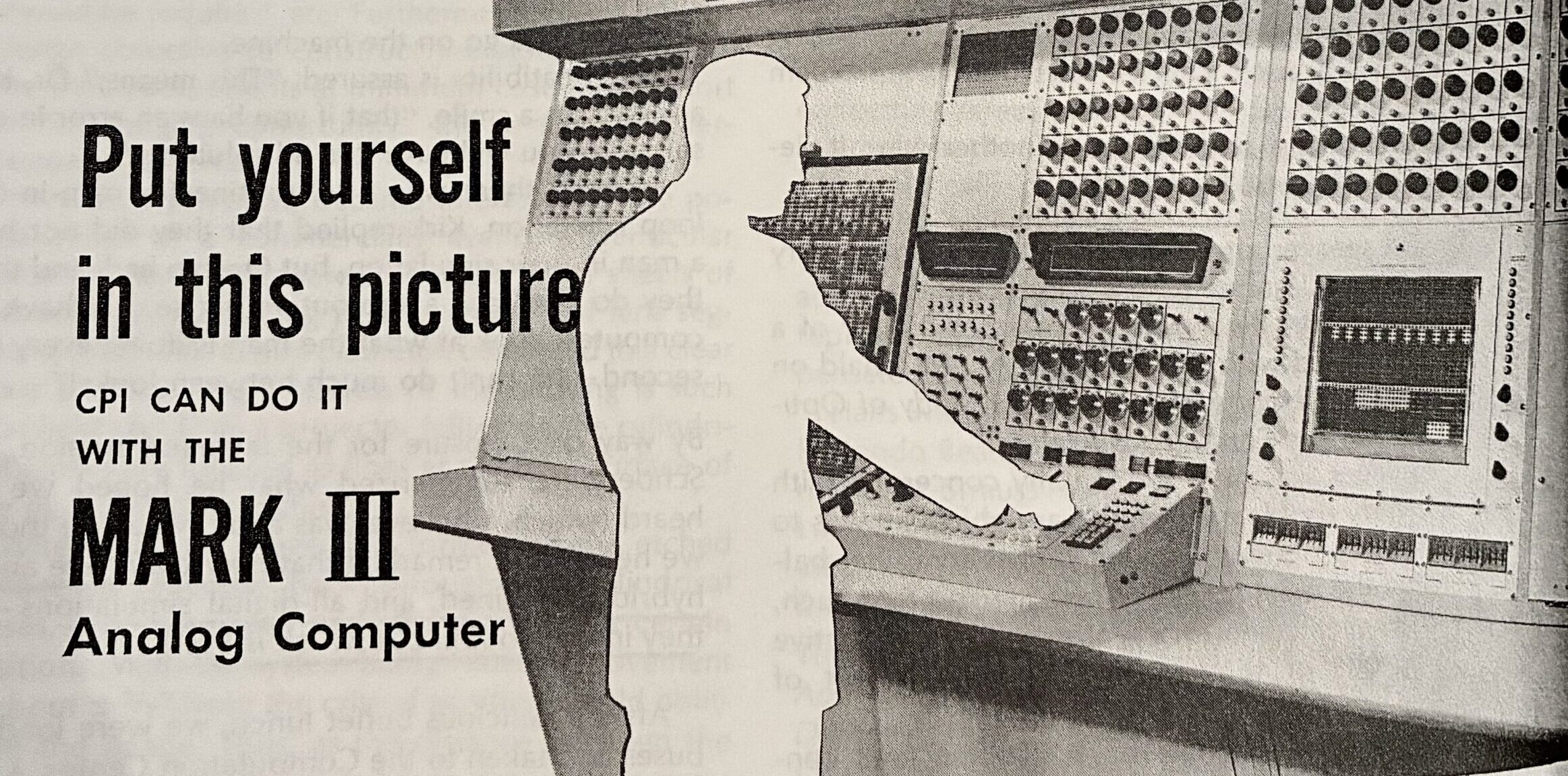
The power and presence of AI in our lives are not only the mathematics, the algorithms, or the devices. Nor is AI just an evolving crime scene of intellectual property theft. Nor does it simply reify our enthusiasm for the solitary pleasures of the screen. On the contrary, AI is all of these things and more. The power and presence of AI is not singular but relational and distributive. It is a matter of connection and saturation, of threading through and across. There are many names for this kind of thing. A discourse that makes its way underneath the skin. A political economy fueled by proclivities for authoritarianism. An epistemology that trades in empty spectacle. An algorithmic cage or, if you are so inclined, various sites of extraction and local exploitations animating the atmosphere that we all live in and through.
AI-driven systems, and the screens that facilitate them, operate according to paradigmatic theories of neural networks and information processing.
At the conceptual level, these screens and these systems assume the human to be the sum of its relations, both internal and outward, a complex, self-organizing system that processes information.
At the material level, the screens and the large language models they mediate have been trained to scrape the relations of the ‘individual’–to their friends, family, celebrities, a particular pair of shoes or type of kink, etc. And they have been trained to parse the sum of these relations for patterns, ranging from the obvious to the heretofore unrecognized.
At the experiential level, then, screen cycles of capture and extraction are the pulsing heart of the brain-centric Leviathan now being constructed through generative AI and the large language models that surround us.
Kate Crawford has called this the “metabolic logic of AI slop,” in order to underscore that the experience of capture and extraction is, among other things, biological. In any case, these experiences are increasingly the default space where the practice of our humanity happens.
Such an overwhelming and massively mediated vision of the human as inherently computational is the metaphysics–sometimes acknowledged, sometimes not–that so often drives conversations about, and strategies to align, screen-addled AI systems with the human scene.
Which is to say that neural networks are no longer simply in our brains. On the contrary, neural networks are now the products of massive feats of human engineering and capitalization. They are disciplinary and are generating new horizons of biopolitical machinations.
This moment is part and parcel of what I have previously called a history of the “neuromatic” brain. The neuromatic paradigm has long inspired those who fund, build, and dream of machines that might capture the all-but-infinite complexity of the world, machines that could process what they had captured, and then recognize deep and abiding patterns about the world and each of its parameters.
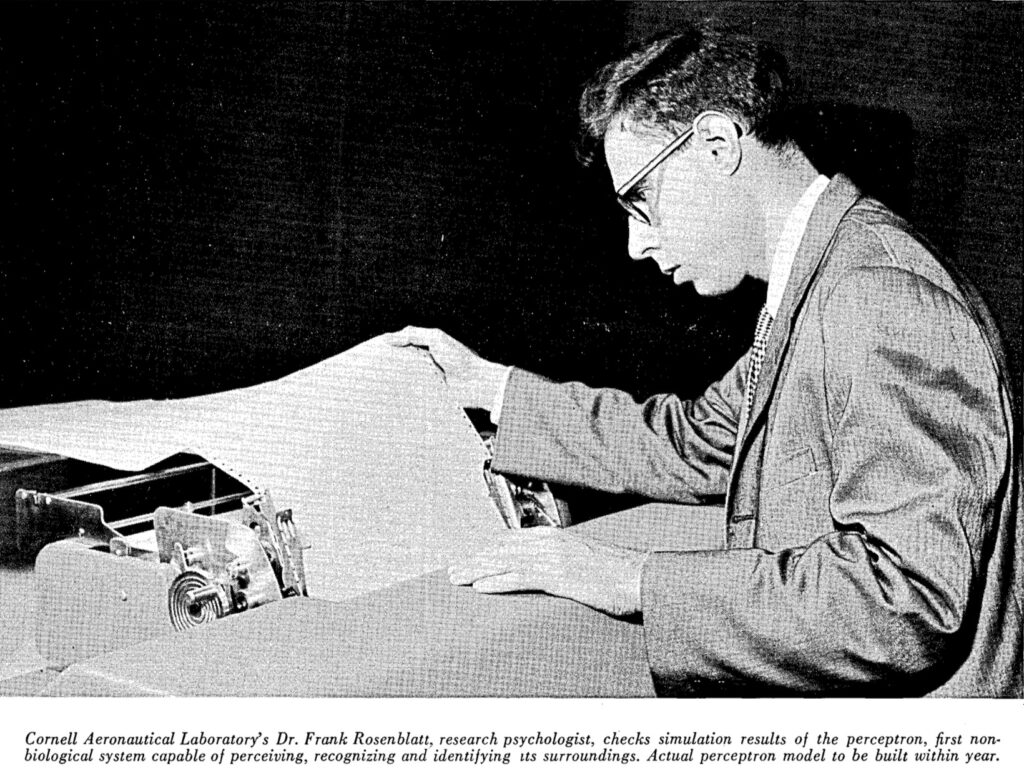
Set off by the consequential integration of the “logical calculus” of Warren McCulloch and Walter Pitts (1943) and Claude Shannon’s mathematical theory of communication (1948), the epistemological grooves of large language models were subsequently refined: from Hebbian assemblies and primitive vector machines like the Mark I Perceptron to later developments in Parallel Distributed Processing and back propagation in the 1980s, to the revolution of graphics-processing units, which enormously increased the power and accuracy of neural networks.
At present there is much money afoot, not to mention technological and political power invested in, a day when pretty much everything will be understood, taught, talked about, and lived according to the “intelligence” of artificial neural networks.
There is both an overdetermined and often desperate will to believe in the algorithm. Indeed, many a wager has been made not so much on “superintelligence” but on generative AI soon generating the categories of thought and the grooves of our sociality. Why so much desire to be convinced that its intelligence is sound and complete? Why so much energy spent setting AI apart so as to be worthy of our prostrations before it?
It seems to me that humans, at this particularly vulnerable moment, are living through a season of revival. For ever since the great work of artificial neural networks was wrought, there has been a great abiding alteration in this world in many respects. There has been vastly more conviction, faith, apocalypticism, discipline, ritual, myth-making, whispered prayers, wild claims, and even stranger self-imaginings as neural networks make their way into our lives, as techniques for machine learning find their so-called natural home in us.
There is a tremendous ferment of rhetorical effusions, descriptions, and explanations that evoke the language of religion and the archives of religious history. There is talk of a mutation in Christianity. “Feel the AGI!”—a revival cry for transcendence chanted by employees in the early days of OpenAI—captures the technophilic zeal in some quarters as work begins to create a God in the image of the human. The first glimmers of a new religious order are springing up—from immortalism and cryobiology to effective altruists, tech accelerationists, and the “AGI-theism” of the Silicon Valley elite; the latter a mix of prosperity gospel and Jonestown jitters “honed by years of drug-addled betterment sessions and house parties.”
It seems to me that at this moment the psychological and sociological criteria for an honest to goodness baptism of the spirit seem to have been met. Transformation and transgression. Enthusiasm. Splintered politics. Mediation experienced as immediacy. Structure experienced as agency. Bliss. Terror. Intimations of transcending the human.
Under AI-driven conditions of capital, work and social life increasingly revolve around the delirious and contagious desire to make each and every moment, each thing or place, each person and relationship, into an object of algorithmic capture and cultic commodification. As the story goes, nothing in all of creation is hidden from the AI-driven systems being imagined and built during these heady days of AI adoption.
All has become a burnt-over district.
When I think about this moment I am sometimes reminded of Charles Chauncey’s acidic remark about the stirring claims coming out of colonial Northampton and the epicenter of the so-called first Great Awakening: “These don’t look like the Fruit of the extraordinary Discoveries of GOD,” quipped Chauncey, “but they are the very Things which may be expected when Men’s Passions are rais’d to an extraordinary Height, without a proportional Degree of Light in their Understandings.”
AI systems, in their massive complexity and capacities for surveillance and prediction, approach the criteria that humans have long used to imagine divinity. And this is salient sociological and psychological data. But these systems are not divine. At least not in a Chauncey or Edwards way. They are, rather, discursive. They are utterly human. They are “systems for probabilistic mimicry” that are ever improving their odds of imitating us–as humans, in turn, imitate their imitators.1 Whither interpretation, when the human has been, by and large, figured out and defined as suboptimal? Whither critique, when the present not to mention the past has been transcended by using not just the machines of secular modernity but also its language and ontological demands?
The subject of artificial intelligence is an opportunity to draw inspiration from the humanities, in general, and the study of religion, in particular, in order to make sense of a rather disturbing turn in our secular age. How to begin to achieve critical leverage on this moment when humans increasingly imagine themselves vis-à-vis AI systems and other computational forms imagining them? Although the computational abstractions that enable this loop are bedazzling, the looping itself is a materialist and even biological process—algorithms monitoring and predicting and managing and mining metadata to “measure the collective production of value and [to] extract a sort of network surplus-value.” Algorithms continuously learning from the humans who are learning from them.
I am very much interested in addressing this looping of structure and human agency by insisting on the reality of AI imaginaries as social and psychic constructions. Rather than dismiss the enthusiasms of AI as fantasy or unreal or neurotic or false consciousness, I want to approach AI by way of the human mechanics of its making and sustaining—empirical and political struggles, the linguistic power, the affective attachments, the social imaginaries, the psycho-sexual politics, the epistemic hegemonies, the blood and sweat and rationalities undergirding, etc.
The digging into the instability and historicity of institutions and worldviews and people who claim, at some level, a mantle of sacred legitimacy–well, this tracks for the future study of AI. And it tracks, too, for getting a critical handle on the inevitable effects of AI training on the human practice of intelligence.
So I stand before you a worried man. I worry about the diminishing of future conversations about AI, the human, religion, and about much else besides. I worry about conversations being squeezed by scarcity and ideology, conversations becoming aesthetically flat, repetitive, ethically obtuse, or devoid of a withering reflexivity. In other words, I worry about conversations producing “knowledge” ready-made for use in training data sets for AI-driven systems.2
Consequently, ours is a moment that demands new vocabularies of analysis and registers of critique. How else to begin to hack the large language models and the human enterprises that seek to calcify—in order to instrumentalize—their common and computational sense?
- On the will to virtuality that animates this auto-erotic loop within early cybernetic speculation, see Elizabeth A. Wilson, “Loving the Computer: Cognition, Embodiment and the Influencing Machine,” Theory & Psychology 6:4 (1996): 577-599. ↩︎
- See, for example renewed interest in multi-agent expert systems in the training of generative AI, an approach that flourished briefly in the 1980s as one of the last gasps of Symbolic AI or GOFAI. Konrad Sowa and Aleksandra Przegalinska, “From Expert Systems to Generative Artificial Experts: A New Concept for Human-AI Collaboration in Knowledge Work.” Journal of Artificial Intelligence Research 82 (2025): 2101-2124; Zhang, Ruichen, Hongyang Du, Dusit Niyato, Jiawen Kang, Zehui Xiong, Ping Zhang, and Dong In Kim. “Optimizing generative ai networking: A dual perspective with multi-agent systems and mixture of experts.” arXiv preprint arXiv:2405.12472 (2024). ↩︎
