
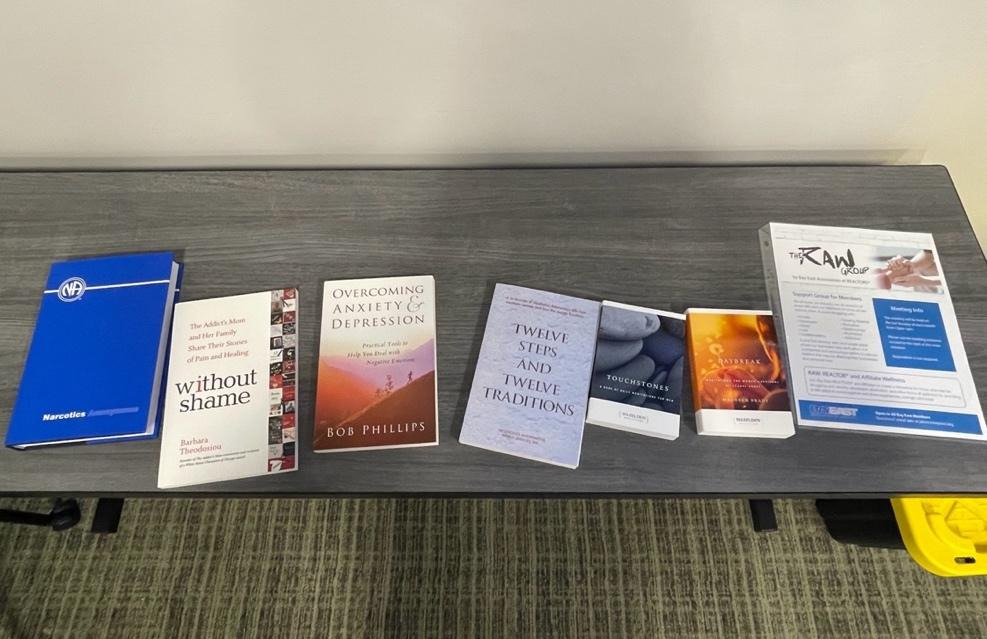
At a closed monthly meeting of the REALTOR® & Affiliate Wellness (RAW) Group, a support group for real estate professionals, a roomful of agents and lenders watched a Goalcast video about an airport barista who described “the secret” of being enthusiastic at work as “pouring happiness” into people’s lives.1Interview and observational data used in this essay were collected under UC Santa Barbara IRB Protocol #13-26-0505. Participants are pseudonymized. When the video ended, Cole, the veteran Realtor facilitating the meeting, reminded everyone of the lesson: “how we show up is all we have.” The barista controlled her own attitude, regardless of circumstances, and that had an effect on her customers. Cole then stated the group’s only rule for the rest of the meeting: “no cross-talking,” so each participant could “feel heard.” Once they began sharing, talk and laughter about property listings and income goals soon gave way to topics such as illness, family strain, and the shared anxiety around the constant need to appear composed in front of clients. Cole explained that RAW meetings began as a support group for real estate professionals struggling with addiction and depression. He had lost colleagues to suicide and wondered whether a group like RAW might have given them somewhere to turn. I was struck by the love they expressed for one another. What I noticed, too, was that RAW brought into contact two streams of New Thought’s legacy: business self-help (by way of the principles of positive thinking) and addiction recovery (by way of Alcoholics Anonymous).
Sitting beside me at this meeting was Sue, who has sold real estate since 1986. When her turn came, she shared that “personal development” had significantly “improved her spirits” during long, turbulent stretches in her personal life and real estate and multilevel marketing businesses. After the meeting ended, she spoke with me in more detail. Every morning before work, Sue explained, she reads for about ten minutes to “keep my thoughts positive and on my goals.” At the time, she was rereading Norman Vincent Peale’s The Power of Positive Thinking, a book she first encountered at a sales seminar hosted by a multilevel marketing company she later joined. The routine, she told me, “gets me out of bed in the morning.”
Sue’s attraction to what she called personal development became clearer as she described her efforts to provide for her family amid the stressors of indeterminate commission work. She entered real estate as a single mother, drawn primarily by the “time freedom” (flexibility) of 100-percent-commission work and the fact that “there was no cap on my check, so it was all up to me.” It also allowed her to spend more time with her daughter, a toddler at the time. Sometimes, weeks of work ended without a livable paycheck. At others, after a dry spell, a referral might arrive out of nowhere. “Selling real estate … I can only control what I can control,” Sue shared with me. “So I focus on personal development every morning before anything else.” At points in her career, Sue had to piece together multiple sources of gig income to make ends meet. Especially during those stretches, personal development provided her a foothold inside that uncertainty, with practical steps on how best to concentrate on the part of the transaction she believed she could actually influence.
What Sue described sounded familiar from my prior research on New Thought. Her daily efforts to direct her thoughts, stay positive, and work on herself echoed practices its spiritual teachers have promoted for generations. But Sue had never heard of New Thought. When I asked her about religion and religious practices, she turned instead to her Christian faith and mentioned Norman Peale. What’s even more apparent is that Sue uses practices learned from sales without being particularly concerned with their origins; their practical effects are sufficient. She spoke of personal development mostly in terms of its fruits in her two businesses and relationships. Clear as day, Sue moved easily among these ideas, an elasticity that New Thought’s own capaciousness helps explain.
In the late nineteenth century, New Thought popularized a constellation of principles that drew from much older, pliant ideas about “correspondences” between celestial power and material life. Catherine Albanese set the tone of the conversation for religious studies to properly appreciate the pervasiveness of the eclectic assortment of spiritual people who practice what she calls “metaphysical religion,” of which New Thought is a significant branch. The scholarly category encompasses many diverse traditions whose practitioners borrowed and recombined ideas about the power and purposes of the human mind. Recent histories of New Thought’s oft-cited male teachers and the women who drove much of the movement show widespread disagreement over the relationship between individual and celestial power. Yet they did agree on a shared interest in what a properly guided mind could create. Quintessential rags-to-riches stories about prominent Americans had already attuned the public to the idea that success was something one could generate for oneself, whatever the circumstances. New Thought offered that dreamscape a supernatural grounding, teaching people to deny present conditions, picture different ones, and work on themselves through ordinary, repeatable practices. By 1902, William James observed that New Thought principles had begun to “pervade the air.”
Spiritual practices drag along residue from their religious past even if they move beyond the settings that once moored them. Religion is not always clear cut. Scholars have also concluded that spiritual people need not acknowledge those histories for them to tacitly shape what they think and do. The principles and practices of positive thinking, derived from New Thought, offer an especially everyday example of this movement in American life. By the time Sue encountered these practices, they had already found new moorings in sales as “personal development.”
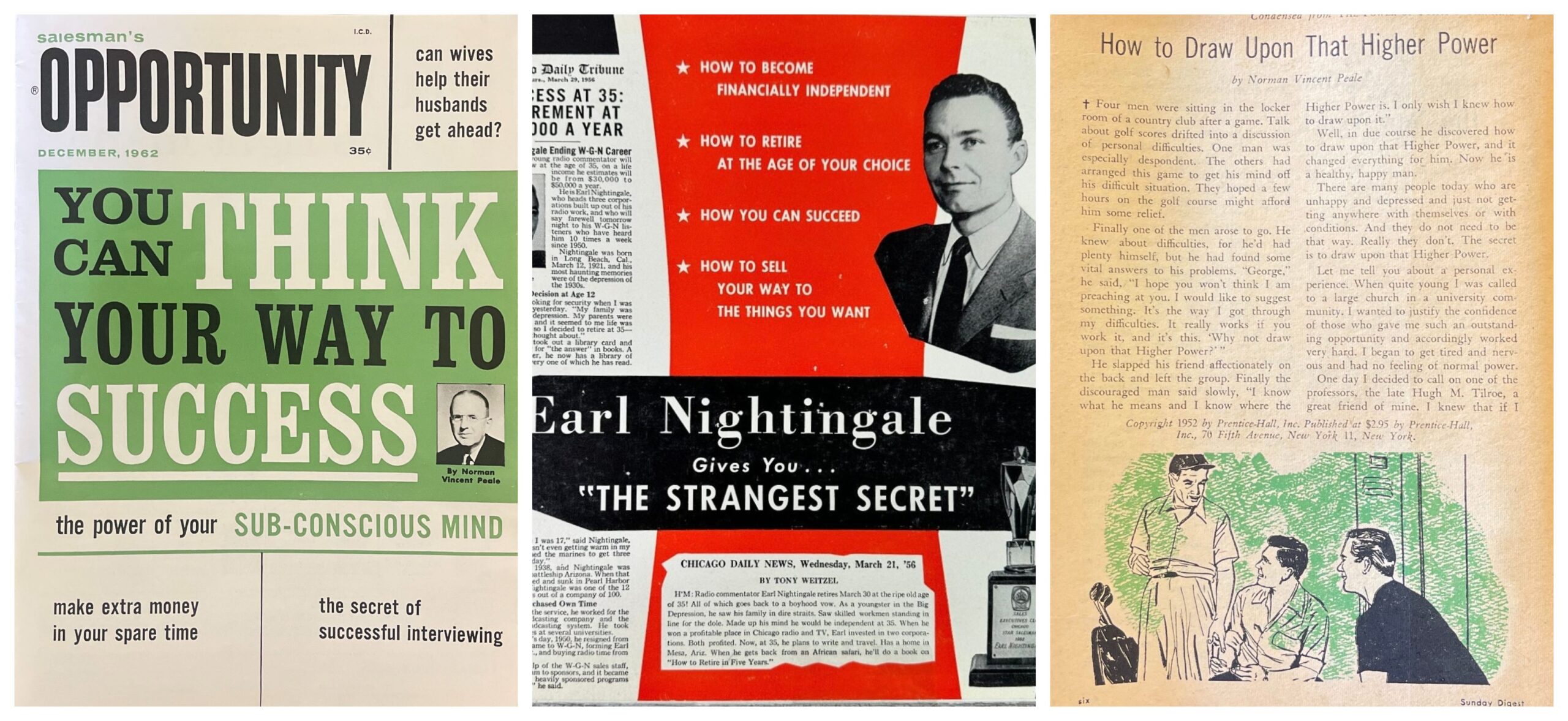
What Sue didn’t know was that the sales profession writ large had long been receptive to the spiritual principles she found useful in her businesses. Walter Friedman documents why and how early-twentieth-century corporations looked to “professionalize” the trade. To do so, companies incessantly trained salespeople to cultivate a persistent sense of self-confidence, optimism, and personal discipline. In every generation for the last two centuries, New Thought thinkers entered and helped shape that developing sales culture around its principles. William Walker Atkinson’s The Psychology of Salesmanship, published by New Thought writer Elizabeth Towne in 1912, translated the doubt and fear that accompanied the selling trade into psychospiritual steps to managing one’s feelings and thoughts about those feelings. Orison Swett Marden urged sellers to spend their recreation time “re-creating” themselves “physically, in mind, and in spirit.” The salesperson’s mind — and increasingly the subconscious mind — became yet another instrument to train.
Over time, New Thought popularizers increasingly emphasized the power held within their principles and practices apart from the cosmologies that once explained them. In 1942, Ernest Holmes, founder of the New Thought denomination Religious Science, defined positive thinking as “thinking without reference to negatives.” Norman Vincent Peale and his wife, Ruth Stafford Peale, worked together to recast Holmes’ New Thought for postwar Americans through a well-worn Protestant idiom of “practical Christianity.” Over five decades, the Peales taught countless readers and listeners to visualize desired outcomes and, by holding that vision in mind, build lasting self-confidence. Chicago radio broadcaster and insurance-agency executive Earl Nightingale was one of many to distill similar instruction into an especially portable sales repertoire. In his 1956 record “The Strangest Secret,” Nightingale instructed listeners to write a goal on a card, picture its achievement, and redirect fearful thoughts for thirty days. Positive thinking offered sellers a way to place rejection within a grander narrative about future success. That repertoire has continued to change shape. Some contemporary sales trainers with massive online audiences have traded the suit and tie for displays of bodily discipline. The message, age-old, is that success in sales begins with mastery of the self. That a version of this belief has been embraced by the sitting President of the United States should quell any lingering doubt about its reach.
New Thought’s continued resonance with salespeople, even shorn of some of its former cosmologies, illustrates a longstanding argument in scholarship on business and religion that I carried with me to my fieldwork: that religion and economy are co-produced. The affinity also made me wonder how much New Thought owes its longevity to its kinship with enduring American stories of self-making. After observing salespeople at work, I am less convinced that we can — or should — neatly separate these entangled religious inheritances in business. For those I interviewed, personal development is the connective tissue between metaphysical claims about the mind’s power over material life and ordinary sales tactics. Some dug deeper in pursuit of richer personal development material and discovered a tradition lying underneath. Many have not and knew nothing of the histories I trace in this essay. So much of commission work was beyond the seller’s control, but all of them felt they could choose to focus on and improve their mindset.
An MLM seminar introduced Sue, my seat neighbor at the aforementioned RAW meeting, to Peale’s positive thinking and the New Thought-inspired world of personal development. The RAW Group itself drew on a different institutional history with a link to New Thought: Alcoholics Anonymous.
At a statewide REALTORS® conference, Cole noticed “Friends of Bill W.” on the schedule and went looking for an AA meeting. The assigned room was empty. But, another Realtor eventually showed up. Their conversation about the particular pressures Realtors face set RAW’s creation in motion. Many of its early attendees also met at local AA meetings. RAW was initially intended to support Realtors struggling with addiction, but its purview soon widened. In our interview, Cole didn’t describe RAW as an addiction program at all. He said “it’s really a life thing.”
AA’s ties to New Thought extend back to its earliest years. Before the organization possessed much literature of its own, members read and shared Emmet Fox’s The Sermon on the Mount, which interpreted Jesus’s teachings through New Thought metaphysics. AA cofounder Bill Wilson frequently cited William James and recommended The Varieties of Religious Experience to members grappling with AA’s spiritual language. Wilson later called James an unwitting founder of Alcoholics Anonymous. The practice of sharing spiritual literature continues at RAW meetings, where AA and Narcotics Anonymous (NA) texts are on offer.
Cole’s own account made the connection to New Thought seem more than circumstantial. Describing recovery, he called himself “powerless in my own life.” Later, with equal conviction, he told me, “You can do anything if you have the will to do it,” and spoke about the power of the mind in shaping what happens in everyday life. Fox likewise believed that surrendering self-will and changing one’s circumstances through consciousness work were not contradictory pursuits. RAW brings those two orientations together. Its AA inheritance makes space for what lies beyond the seller’s control, while personal development turns attention toward the thoughts, habits, and actions still open to change. Participants in RAW meetings need not reconcile those claims. Their practical compatibility for the sales world’s competitiveness is plenty.
Revealed in the stories of Sue and the founding of RAW are two different avenues with which New Thought enters the sales profession. Whereas Sue encountered positive thinking through an MLM sales seminar and incorporated its teachings into her daily routine, RAW’s inheritance is institutional and mediated. There, New Thought ideas passed through AA, mingled with other traditions, and took on new life in a support-group form whose participants may never identify the movement by name. Sue expressed that RAW meetings felt very comfortable. She was encouraged to know that, in the pursuit of her business goals, she didn’t have to put on a mask to cover her journey’s difficult moments.
Sales does more than house those shared inheritances. The volatility of commission work calls for practices of self-cultivation that enable responses to uncertainty. But this also introduces a liability. When personal-development teachings repeatedly direct sellers toward themselves as the part of the transaction they can improve, setbacks produced by external forces register as failures of the self. That logic of self-mastery common to contemporary forms of spirituality has, elsewhere in the personal-development world, been taken to deadly extremes. RAW complicates that logic by giving sellers a place to voice their uncertainties and describe pressures they cannot individually master.
The salesperson’s world is a useful place to ask what religion helps us see. A simple subtraction narrative makes religion’s decline appear more straightforward than it is. In the precarious world of commission work, metaphysical claims about the mind’s power have become a kind of good business sense, teaching sellers that success begins with themselves. If salesmanship has been able to make these religious ideas seem ordinary, what else might come into view if we continue to look at public life this way?
